


Western saddles for horses
Added 23.1.2026 14:58.29 Views count 265
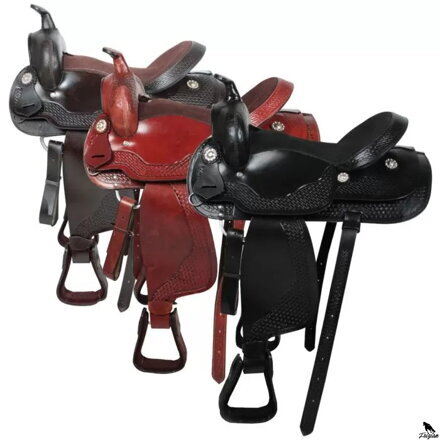
Western saddles are among the most robust and comfortable saddles used in equestrianism. They were developed for long hours in the saddle when working with cattle, which is reflected in their design - they distribute the rider's weight over a large area of the horse and provide excellent stability. Today they are used not only for work, but also for recreational riding, western sports and tourism.
What are Western saddles for?
Comfort on long rides
Even distribution of the rider's weight on the horse's back
Stable rider position
Safe seating during sudden movements of the horse
Possibility of working with a rope (saddle horn)
A Western saddle is ideal for riders who spend a lot of time in the saddle, ride off-road or engage in Western disciplines.
Basic parts of a western saddle
Tree – the base of the saddle, most often wood covered with rawhide or synthetics
Horn – used for working with the lasso
Fork – stability for the rider
Seat – a place for the rider
Cantle – support for the rider's back9
Skirts – distribute pressure on the horse's back
Stirrups – support for the rider's legs
Cinch – attachment of the saddle
How to use a western saddle
A western saddle blanket is placed on the horse
The saddle is placed slightly forward and moved back to the correct position
The withers are checked for looseness
The girth is tightened gradually (never suddenly)
After a short walk, the girth is tightened further
The saddle must fit tightly, but must not press so as not to cause abrasions or pain.
Types of Western saddles
1. Ranch / Working saddle
Designed for everyday work with cattle.
Advantages:
Very durable
Stable and safe
Suitable for long rides
Disadvantages:
Heavier
Less comfortable for beginners
2. Reining saddle
Lighter and deeper saddle.
Advantages:9
Excellent contact with the horse
Suitable for precise maneuvers
Light weight
Disadvantages:
Less comfortable for long rides
3. Cutting saddle
Saddle for quick sideways movements.
Advantages:
Maximum stability
Helps maintain balance
Excellent lateral support
Disadvantages:
Specific use
Higher price
4. Barrel racing saddle
Short, light and compact.
Advantages:
Extreme stability
Quick rider response
Low weight
Disadvantages:
Not suitable for long rides
Less comfort
5. Trail (touring) western saddle
Ideal for recreational riding.
Advantages:
High comfort
Lower weight
Often equipped with luggage holders
Disadvantages:
Less suitable for sports disciplines
6. Show western saddle
Richly decorated saddles.
Advantages:
Representative appearance
High quality of workmanship
Disadvantages:3
High price
Not suitable for everyday riding
Advantages of Western saddles
High comfort for horse and rider
Even weight distribution
Stable rider position
Safe during sudden movements
Suitable for long rides
Disadvantages
Heavy weight
Larger dimensions
More difficult to choose the right size
Higher price of quality models
How to choose the right Western saddle
1. Frame type (tree)
Quarter Horse bars – wider horses
Semi Quarter Horse bars – narrower horses
Full Quarter Horse bars – very wide horses
2. Seat size
Usually 14" – 17" (depending on the rider's build)
3. Shape of the horse's back
Height of the withers
Width of the back
Length back
4. Purpose
Work / sport / recreation
5. Saddle weight
Lighter for smaller horses and women
Heavier for work use
Western saddle care
Regular leather cleaning
Using oils and balms
Checking the frame and seams
Storing on a stand
Most common mistakes
Incorrect frame width
Saddle too heavy for the horse
Neglecting the saddle pad
Incorrectly tightened girth
Western saddles are comfortable, stable and very versatile if they are chosen correctly. The key to success is the correct frame size, suitable saddle pad and regular inspection. A well-fitting Western saddle increases the performance, safety and well-being of both horse and rider.
Tags
- Western saddles are among the most robust and comfortable saddles used in equestrianism. They were developed for long hours in the saddle when working with cattle
- which is reflected in their design - they distribute the rider's weight over a large area of the horse and provide excellent stability. Today they are used not only for work
- but also for recreational riding
- western sports and tourism.