


Tancho
Added 16.2.2026 20:09.21 Views count 335
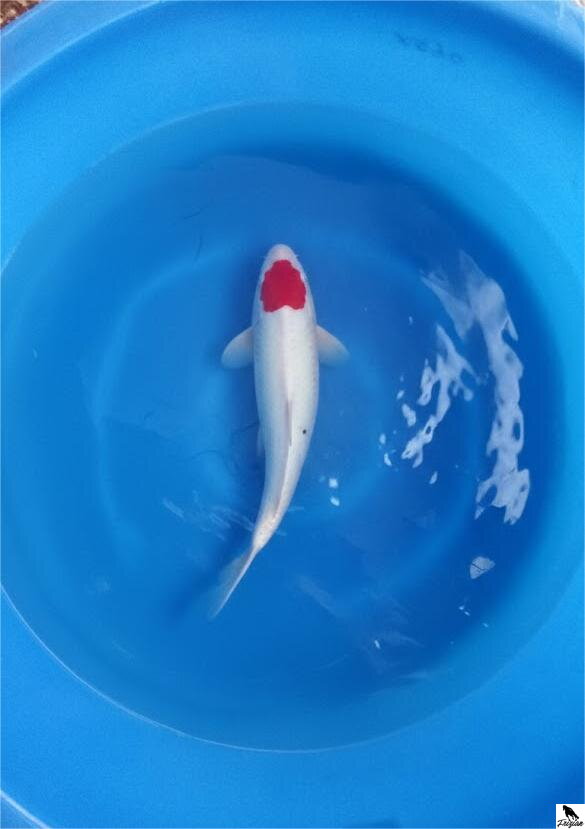
In the world of Nishikigoi (ornamental carp), there are few varieties that carry such strong symbolism and national pride as the Tancho. With its appearance, which resembles the Japanese national flag (Hinomaru), it has become the embodiment of purity, elegance and nobility. Tancho is not a genetically distinct variety in the true sense of the word, but rather a unique color trait that can appear in several species.
Appearance and characteristics
The name "Tancho" is derived from the Japanese crane (Grus japonensis), which has a typical red spot on the top of its head.
The ideal Tancho must meet strict aesthetic criteria:
Snow-white body: The base color (Shiroji) must be pure, without any spots, yellowish tinges or black dots (Shimi).
Red spot (Hi): Must be located exclusively on the head, ideally between the eyes. It must not extend to the shoulders or cover the eyes or nose. A perfectly regular circle is the most valuable, although heart, diamond or oval shapes are also acceptable, as long as they are symmetrical.
Color saturation: The red must be deep, intense and with sharp edges (Kiwa).
There are three main subgroups:
Tancho Kohaku: Pure white body with a red spot (the most popular).
Tancho Sanke: White fish with a red spot on the head and a black pattern (Sumi) on the body.
Tancho Showa: Black fish with a white pattern and a red spot on the head.
Size and growth potential
Tancho Kohaku has the potential to grow to respectable sizes, often exceeding 70-85 cm, if they come from a quality bloodline (for example, from breeders such as Sakai Fish Farm or Dainichi). Their body should be torpedo-shaped with powerful shoulders, which gives the red spot on their head even more dominance.
Behavior and Temperament
Tancho are generally peaceful and sociable fish. Like other Kohaku, Tancho are often more docile and courageous than metallic varieties. They learn to take food from your hand very quickly and become the "leaders" of the feeding process, which makes it easier to control the health of the entire pond population.
Weaknesses and genetic lottery
The biggest weakness of this variety is the instability of the red spot.
Caution: If a Tancho loses its red spot (e.g. due to stress, poor water quality or mechanical injury), the spot will never recover. This turns a valuable Tancho into an ordinary white carp (Shiromuji), which has almost zero value in the eyes of collectors.
Genetically, it is very difficult to breed a quality Tancho. They are not created by mating two Tanchos, but rather by a "lucky accident" in Kohaku breeding. Out of tens of thousands of litters, only a few individuals are born with a perfect head spot.
Health Risks and Diseases
The Tancho is not more susceptible to common diseases (such as spring viremia or parasites) than other varieties, but its **white coloration** is a sensitive indicator of water quality.
Pinkish skin coloration: If the white area begins to take on a pink tinge, it is almost always a sign of high stress, ammonia irritation, or a sign of an incipient bacterial infection.
Sunburn: In very shallow and clear ponds without shade, the red spot can be damaged by UV radiation (so-called "burning"), leading to fading of the pigment.
Breeding conditions and advice for owners
To keep your Tancho in top condition, focus on the following factors:
Water hardness: Tancho (especially its white component) loves softer water. Water that is too hard can encourage the formation of black spots (Shimi), which spoil the pure white appearance.
Quality food: Use food containing natural dyes (spirulina, astaxanthin), but in moderation. Excessive "dyeing" can cause the snow-white body to turn yellow.
Shade: Provide a water lily zone or artificial shading in the pond to protect the pigment from direct summer sun.
Minimal stress: Since the loss of the spot is irreversible, avoid unnecessary handling and sudden changes in water parameters.
Tancho is an investment in beauty and peace. It rewards the owner with its majestic swimming, which, in contrast with the blue water and green plants, creates a living work of art.