


Jutland horse
Added 24.1.2026 20:26.32 Views count 321
The Jutland horse (Den jyske hest / Jutland horse) is a medium-sized cold-blooded draft horse from Denmark, which originated and was bred on the Jutland Peninsula in the northwest of the country.
📜 Origin and history
Origin: the breed originates from the Jutland Peninsula in Denmark, from where it gets its name.
Ancient roots: pictorial evidence suggests that horses similar to the Jutland were used as early as the 9th century, and there are written references from the 12th century.
Development: the breed was formed in the 19th century, when English draft breeds (e.g. Suffolk Punch, Shire) were brought to Jutland, which increased its strength and working qualities.
Official recognition: in 1881, an official stud book and breeding association (Avlsforeningen Den Jydske Hest) were founded.
Decline in numbers: with mechanization after World War II, the breed ceased to be the main farm horse and its numbers dropped drastically — in the 1950s there were over 15,000 horses, today the breed is endangered and with a population of approximately ~1,000 horses.
🐎 Appearance and standard
📏 Size
Height: approx. 15.2 – 16.1 hands (≈ 152–165cm) at the withers.
Weight: approx. 650–800kg – strong and muscular build.
🐴 Exterior
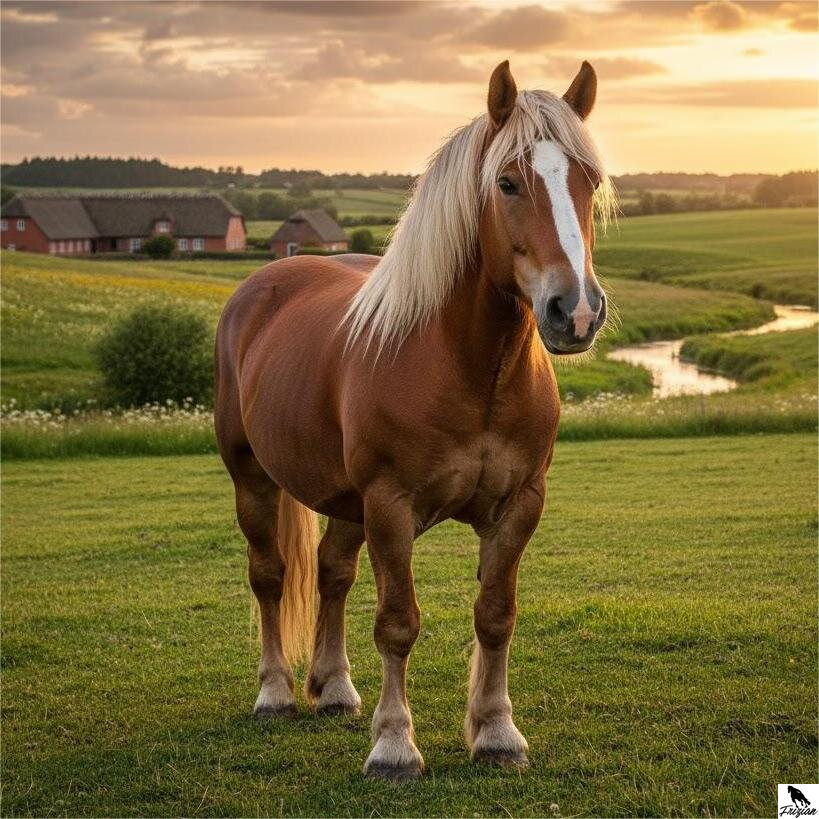
Coat: typically red / chestnut color – is considered the national color of the breed. However, darker shades or other colors with a light mane may also appear.
Body: compact with a deep chest, wide rump, short and strong back.
Limbs: strong, wide hooves and often prominent feathering on the legs characteristic of cold-blooded breeds.
Head and expression: large head with a slightly convex profile and a good-natured expression, which complements its calm character.
🧠 Nature and Temperament
The Jutland is known for its gentle, balanced nature, which is why the breed is highly valued:
✔️Calm and balanced temperament - not easily frightened, stable even when working.
✔️Willing to work and cooperate - quickly learns tasks in a harness and when riding.
✔️Patient and tolerant - also suitable for less experienced breeders and a family environment.
✔️Intelligent and docile - responds well to clear, consistent leadership.
✔️Reliable and stable when working hard - was selected for this type of task.
🏡 Life and requirements
🐴 Accommodation
Needs a spacious stable with good ventilation and dry ground.
Daily run or grazing is important to maintain fitness and psychological well-being.
🍀 Nutrition
Quality hay and grass are the basis — supplementary feeds according to the load.
Water must be available non-stop, because these horses have a greater metabolic demand when working.
🧼 Care
Regular hoof care and hoof trimming.
Checking the condition of the coat, skin, teeth and musculoskeletal system.
Regular deworming and vaccination according to local customs.
🐎 Movement and work
In the past, it was a draft and agricultural horse, today it is used mainly in equestrian and harness performances, draft work for forestry and organic agricultural work, as well as for shows or tourism.
🩺 Health status and common diseases
💪 General health picture
The Jutland is a hardy and robust horse, well adapted to the Nordic climate, with high physical endurance.
⚠️ Potential health risks
Joint problems / osteochondrosis (OCD) - heavier drafts may be at higher risk of degenerative changes in the joints.
Overweight or metabolic disorders if the horse is insufficiently exercised and "overfed".
Hoof problems if regular care and appropriate diet are not provided.
💡 Prevention: a balanced diet, regular exercise, adequate hoof care and regular veterinary check-ups significantly reduce the risk of developing chronic diseases.
🐎 Species and lines
📌 The Jutland is its own single breed, but within the breed there are different pedigrees and lines that differ in strength, muscle mass and BREEDING focus - for example, lines selected for heavier draft work vs. those more for sports use or entertainment.
In practice, however, it is not divided into different "subspecies" as with some other breeds - it is a single population, differing only in size and specific breeding lines.
🌟 Advantages and disadvantages
👍 Advantages
✅ Strong and robust horse suitable for shallow draft tasks.
✅ Calm and balanced nature - easy to control and cooperates well.
✅ Versatile - suitable for driving, riding and heavy work.
✅ Historical and cultural value - it is the national breed of Denmark.
👎 Disadvantages
❌ Endangered population status - the breed is not commonly available.
❌ Requires a lot of space and care (not suitable as a small hobby horse) - a strong enclosure and proper nutrition are needed for draft tasks.
❌ Higher maintenance costs than lighter riding breeds (e.g. large amounts of hay and hoof care).
🐎 How to Choose a Jutland Horse
If you are considering buying or adopting:
✔️ Find out the pedigree and breeding history - verified lines in the stud book.
✔️ Observe the health condition - good hooves, even weight, no obvious lameness or arthritis.
✔️ Test the temperament - when working on a leash or in a harness, it must be calm and willing to cooperate.
✔️ Consider the purpose - whether you want it for harness, riding, heavy work or combined use.
📌 Summary
The Jutland Horse is a Danish draft coldblood with a compact, muscular build and a calm, hard-working temperament.