



Horse girth
Added 23.1.2026 10:48.45 Views count 274
The girth is an integral part of a riding saddle. Its main function is to secure the saddle on the horse's back and prevent it from shifting during riding. Although it may seem like a simple piece of equipment, the correct selection and use of a girth has a fundamental impact on the comfort, performance and health of the horse.
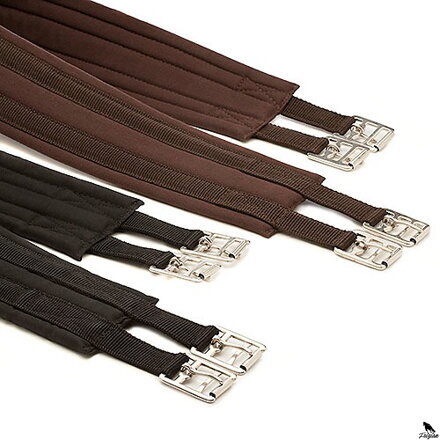
What is a girth and what is it for
A girth is a strap that goes under the horse's belly and connects the two sides of the saddle. It helps:
to stabilize the saddle,
to distribute pressure evenly across the horse's chest,
to increase rider safety,
to prevent the saddle from shifting or rolling.
A properly selected girth should allow the horse to move freely without causing pressure or restricting breathing.
How to use girths
The girth is attached to the saddle using buckles (stirrup straps). It is tightened gradually - first lightly when the saddle is put on and after a short time again when the horse relaxes.
Approximately two fingers should fit between the girth and the horse's body. The girth should not be too tight so as not to restrict breathing, nor too loose so that the saddle is unstable.
Types of girths
By riding style
English girths6
Shorter, with buckles on both ends
Used in dressage, jumping and recreational riding
Western girths
Wider, often softer
Fastened with knots or buckles
By shape
Straight girth – classic shape
Anatomical girth – shaped for freedom of movement
Half-moon girth – suitable for horses with sliding saddles
Dressage girth – longer, narrower
By material
Leather girths – elegant, strong
Textile girths – soft, affordable
Neoprene girths – easy to wash
Gel and memory girths – absorb pressure
Sheep (lamb) girths – very comfortable
Advantages of each types
Leather:3
Long-lasting
Suitable for racing
Textile:
Comfortable
Good breathability
Neoprene:
Easy to maintain
Suitable for sports
Lambskin:
Minimizes pressure sores
Ideal for sensitive horses
Disadvantages of saddle pads
Incorrect size causes pressure sores
Poor quality material can irritate the skin
Too tight fastening restricts breathing
Some materials retain heat
How to choose the right saddle pad
When choosing a saddle pad, the following should be taken into account:
type of saddle,
body structure of the horse,
skin sensitivity,
riding discipline,
length and shape,
quality of buckles and seams.
The saddle pad should lie flat, not press behind the elbows and allow natural movement.
Care of saddle pads
Clean after every ride
Treat leather with balm
Wash textile and neoprene according to instructions
Check for cracks and buckles
Most common mistakes
Tightening too quickly
Using a dirty saddle pad
Incorrect length
Ignoring the horse's reactions
The saddle pad is an essential element of riding equipment that directly affects the comfort and safety of both horse and rider. A properly selected, adjusted and maintained saddle pad ensures saddle stability without pain or restriction of movement.
Tags
- The girth is an integral part of a riding saddle. Its main function is to secure the saddle on the horse's back and prevent it from shifting during riding. Although it may seem like a simple piece of equipment
- the correct selection and use of a girth has a fundamental impact on the comfort
- performance and health of the horse.