



HISTORY OF HORSES FROM SPAIN
Added 11.2.2023 9:02.02 Views count 2095
The Andalusian Horse, Untouched by Time The Spanish horse, sought after and respected throughout equine history, is characterized by a proud stance, bravery, nobility and strength with expressive movements.
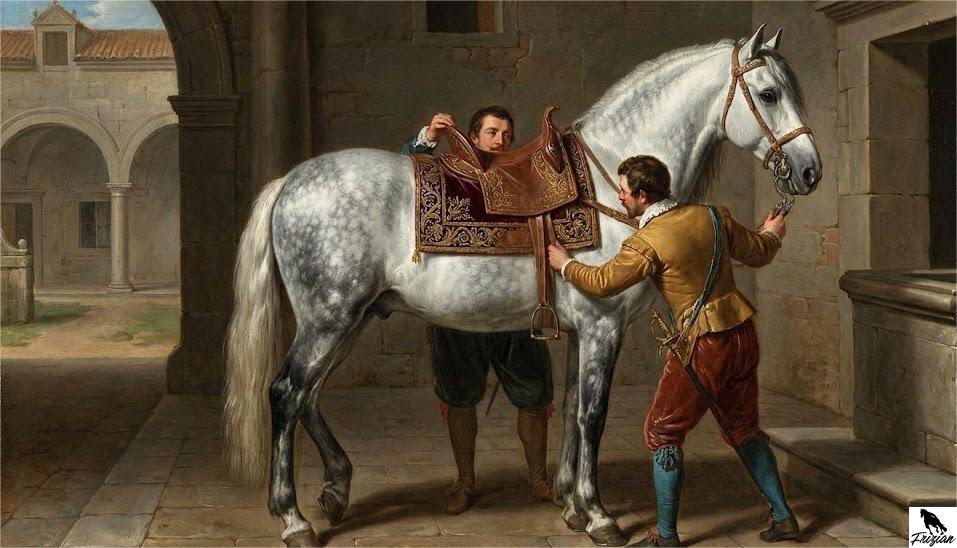
History of the Horse
The history of the horse would be incomplete without the Andalusian horse. Cave paintings depict horses in Iberia in 30,000 BC. In 450 BC, they were the best war horses, soldiers usually rode only stallions, and today most Spanish riding horses are stallions. spanish horses Andalusian
In the 13th century, information about horses was kept by Carthusian monks, who were trusted by the nobility. In the 15th century, the monasteries of Seville, Cazalla and Jerez created stud farms, thanks to which the Andalusian horse became a distinct breed. Records of the bloodline began with the stallion El Soldado, who, when bred with royal mares, produced the founding sire Esclavo.
In the 16th century, Andalusian horses were considered the best in the world. Thanks to their strength, agility and nobility, they were prized by lords and kings.
Throughout the history of horses, it is the art of many monarchs riding Spanish horses. They were introduced to England in the 12th century for knights of war, and under Henry VIII. the royal stud farms at Tutbury and Malmesbury bred Andalusians.
The Spanish horse today is very similar to what it was in the 17th century, when riding masters praised its unrivaled quality for high school work.
"The noblest horse in the world, the most beautiful that can be. It is of great spirit and great courage and docile; it has the proudest trot and the best action at the trot, the most noble gallop and it is the most beautiful and gentle horse and of all the most suitable for a king on the day of his triumph". ~ William Cavendish, Duke of Newcastle, 1667.
Spanish RidingThe horse did not develop without threats, however. In the 18th/19th centuries, Andalusians were captured for war, with only one herd being hidden from Napoleon, saving the line. An epidemic in 1832 seriously threatened the breed, but a small group protected by Carthusian monks survived.
Over time, the emphasis shifted to Thoroughbreds and Warmbloods, reducing the number of Spanish horses. However, the breed recovered, with the Seville Horse Fair in 1869 boasting over ten thousand horses.
Influences on other horse breeds
Many breeds have been influenced by Andalusian blood. These include Thoroughbreds, Connemara ponies, Lipizzans, Neapolitans, Kladrubals and Groningen horses. The German breeds, the Oldenburg, Hanoverian, and Holsteiner breeds, and the Dutch, Gelderland, and Friesian breeds have Spanish blood. In Denmark, the Knabstruber and Fredericksburg. The Alter Real Lusitano, the Warlander (Andalusian/Friesian), and the Andalusian/Percheron known as the Spanish-Norman have Spanish blood. Many American breeds have Spanish ancestry.
Skills
Andalusians are extremely adaptable and docile. They have been used for war, cavalry, tillage, bullfighting, and as cattle horses. Perhaps their best-known skill is classical dressage. Such is their talent for the classical art; they are increasingly being used to produce offspring to specialize in this discipline. Their compact proportions, intelligence, and energetic strength make them ideal for collected movements and lightness over the ground.
Their strength and intelligence make them popular in movies. In the epics Gladiator and Braveheart, you can't help but notice the incomparable fire and history of the Spanish horses' horse eyes. The stamina and courage of the mare and stallion in Legend and more in King Arthur, Elizabeth, Lara Croft and Interview with a Vampire.
They were and remain the obvious choice, even in fantasy adventures such as The Chronicles of Narnia and The Lord of the Rings. Not only for their beauty, but also their bravery, agility and obedience make them ideal for demanding, noisy and crowded action sequences. Once you start noticing them in the movies, you will be surprised at how many Spanish horses are used in them.
Throughout the history of horses, the Andalusian horse remains to this day, as it has been for centuries. Distinctive and incomparable in elegance and beauty, it has fire and grandeur in equal parts. Majestic, lively and all-round durable. It is truly a mount fit for a king.