



Garden pond lighting
Added 25.1.2026 13:41.35 Views count 259
Garden pond lighting is not just an aesthetic addition. The right lighting can enhance the beauty of the pond, promote the health of plants and fish, and also ensure safety when moving around the pond at night.
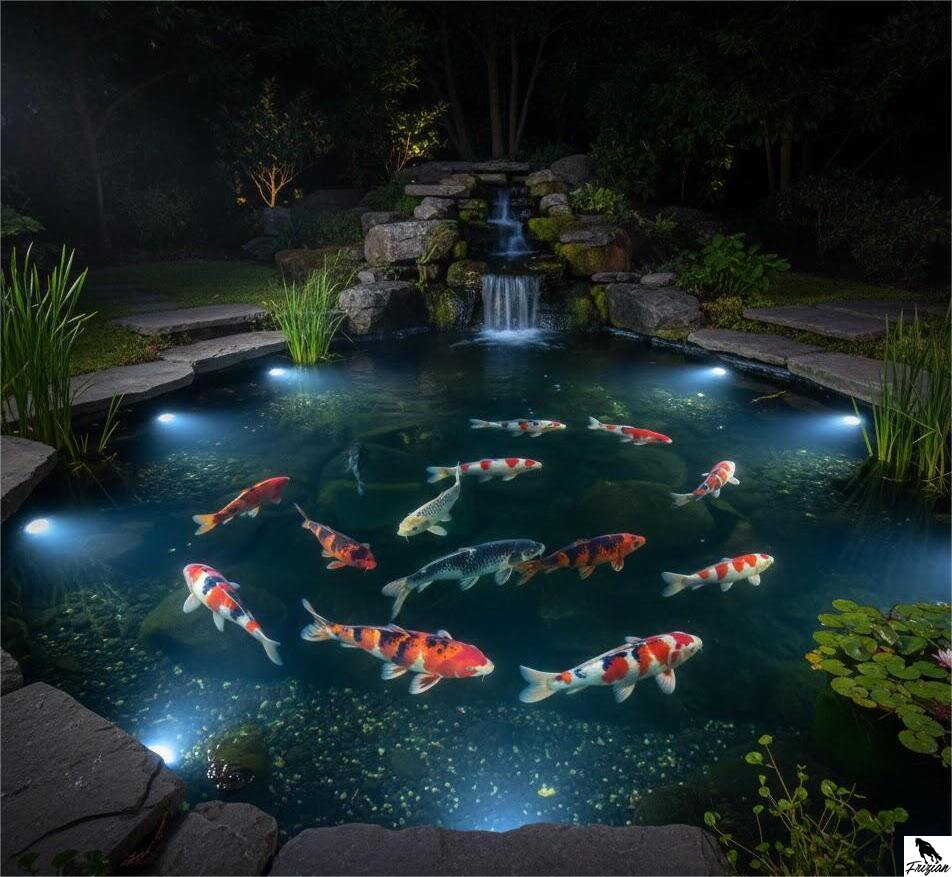
💡 How lighting works
Pond lighting works on the principle of:
Light source – lamps can be LED, halogen or solar.
Light transmission into the water – the light can be placed above the surface, underwater (submersible lamps) or around the edges of the pond.
Effect on the environment – in addition to the aesthetic function, it can support photosynthesis in aquatic plants and regulate fish behavior.
LED lighting is the most popular today due to its low energy consumption, long life and color options.
🌱 Lighting requirements
Pond type and purpose
Decorative ponds → weaker LED lighting or color effects.
Ponds with fish and plants → sufficient light for photosynthesis, without stress for the fish.
Water depth
Submersible lamps must be suitable for a specific depth (e.g. 0.5–1 m or more).
Stability and safety
All lamps must be waterproof and insulated against direct contact with water.
The electrical connection should be via a transformer or low voltage (12 V).
Duration of operation
Some lamps can be turned on all night, others are recommended only in the evening for effects.
🩺 Effect on the health of fish and plants
Positive effects:
Plant growth: LED lighting in white or full-color range supports photosynthesis and healthy plant growth.
Regulation of fish biorhythms: Correct lighting supports the natural daily rhythm of fish, which reduces stress and morbidity.
Aesthetics and safety: An illuminated pond allows safe movement around it in the evening.
Negative effects (if used incorrectly):
Excessive lighting can cause stress to fish and promote excessive algae growth.
An unsuitable color spectrum can negatively affect plant photosynthesis.
⚠️ Common problems and solutions
Low lamp or LED life
Solution: Invest in quality branded products with IP68 certification.
Water penetrates the lamp
Solution: Check the seals, position the lamp correctly and use submersible lamps designed for water.
Too strong light promotes algae
Solution: Use a timer or reduce the light intensity, use a light with a suitable spectrum for plants and fish.
Electrical failure or accident
Solution: Use a 12 V transformer, IP68 protection and regular inspection of the wiring.
🧪 Types of lighting
Type Description Suitability
Submersible LED lamps Placed directly in the water, colored and white light For deep ponds, decorative effects
Solar lamps Powered by solar energy, suitable for small ponds Economical and ecological, less intense light
Edge lights Installation around the edges of the pond, spotlights To highlight edges, waterfalls or plants
Submersible halogen lamps Strong light, high consumption Professional large ponds, large area lighting effect
🛠️ Advantages and disadvantages of lighting
Advantages
Improves the aesthetics of the pond, visibility in the evening.
Supports plant growth with the appropriate spectrum.
Helps regulate the biorhythm of fish and minimize stress.
LED solutions are energy-efficient and water-resistant.
Disadvantages
Incorrect settings can promote algae.
Higher initial costs for high-quality lighting.
Incorrect installation can result in electric shock or damage to the lamp.
📌 How to choose pond lighting
Purpose of the pond
Decorative pond → colored LED effects, solar lamps.
Fish pond → white or full-color LEDs, suitable spectrum for plants.
Size and depth
Small ponds → smaller submersible or solar lamps.
Large ponds → powerful submersible LEDs, or a combination of several lights.
Safety and maintenance
Use lamps with IP68 waterproof rating.
Check for easy cleaning and replacement.
Energy efficiency
LEDs are the most reliable and energy-efficient today.
Color spectrum
For plants → white or full-spectrum LEDs.
For aesthetics → blue, green or RGB effects.
🟢 Summary
Garden pond lighting is a combination of aesthetics, safety and support for the pond environment.
Principle: Submersible or edge lamps illuminate the surface and bottom of the pond.
Requirements: Waterproof, stable installation, suitable spectrum for fish and plants.
Advantages: Aesthetics, healthy plants, less stress for fish.
Disadvantages: Need for proper adjustment, higher price, risk of algae and electrical problems.
The right lighting can bring a pond to life at night, enhance its aesthetics and at the same time support a healthy ecosystem.