



Chagoi
Added 17.2.2026 11:44.02 Views count 603
In the colorful world of Nishikigoi, dominated by bright reds, deep blacks and metallic whites, Chagoi is an inconspicuous fish. However, this variety, whose name translates to "tea carp", has qualities that make it an absolute must-have for any balanced koi pond.
Appearance: Beauty in simplicity
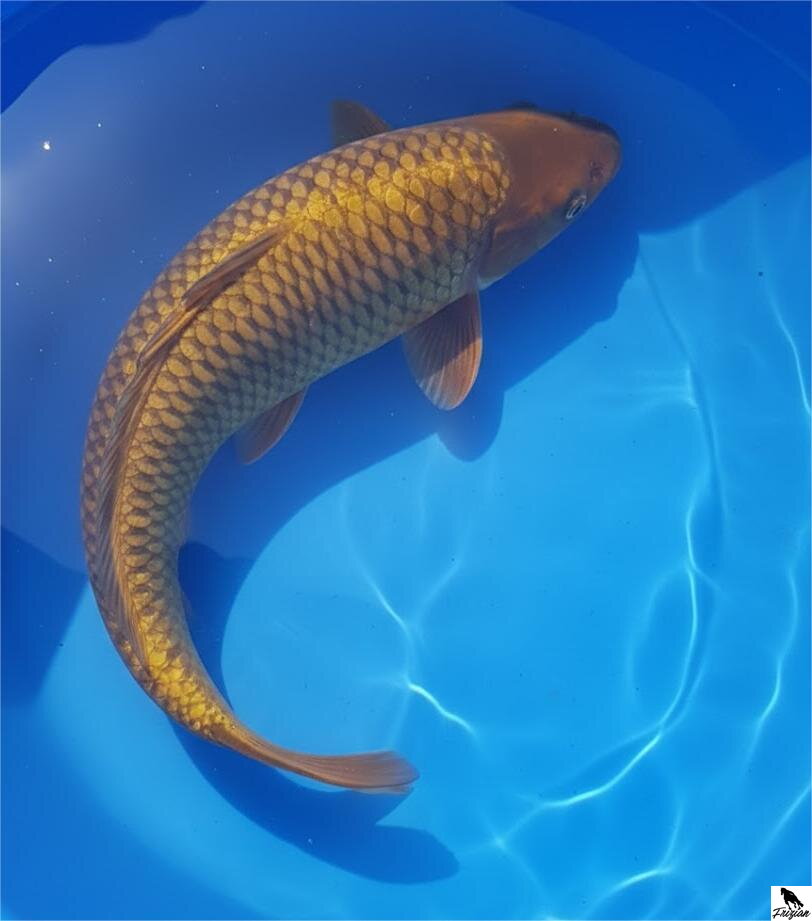
Chagoi belongs to the Kawarimono (unclassified non-metallic varieties). Its beauty lies not in the patterns, but in the texture and purity of its color.
Color spectrum: Ranging from light brown (cocoa), through olive green (Midorigoi) to a rich copper or dark brown color reminiscent of strong tea.
Netting (Fukurin): The most valuable feature is the perfect netting of the scales. Each scale is darkly edged, creating a regular netting effect all over the body of the fish.
Eyes: Unlike other varieties, Chagoi often have prominent, intelligent-looking eyes that enhance their personality.
Size and Growth: Pond Giants
If you are looking for a fish that will surpass the magical 100 cm mark, Chagoi is your best choice.
Genetics: It carries the most genes of the original wild carp, which guarantees it enormous growth potential and a robust body structure.
Shape: A quality Chagoi should have a massive body that maintains its proportions even at extreme lengths.
Behavior: Pond tamer
The biggest asset is its temperament. It is the friendliest and most courageous variety of koi.
Socialization: Chagoi are usually the first fish to start eating from your hand. Other, more shy fish (like Kohaku or Utsuri) will watch its behavior and lose their shyness thanks to it.
Peace: Their presence in the pond reduces the overall stress level of other fish, which has a direct impact on their health and growth.
Weaknesses and diseases
Although Chagoi are considered the "tank" among koi carp, they have their own specifics:
Voracity: Their extreme appetite can lead to obesity if feeding is not regulated. Excess fat can cause problems with spawning in females.
Aesthetic sensitivity to food: Similar to other monochromatic fish, inappropriate food with a high content of dyes can change their natural olive or brown shade to an unaesthetic mottled tone.
Resistance: They handle diseases better than the over-bred varieties. Thanks to a thicker layer of mucus, they are somewhat more resistant to skin parasites, but if a Chagoi gets sick, it is usually a signal that the water quality in the pond is critically poor.
Breeding information and recommendations
Breeding does not require special chemistry, but rather space and proper feeding management:
Water volume: Due to their size, they require large ponds (ideally over 15-20 m3). One adult Chagoi produces significantly more waste than two smaller fish due to their voraciousness, which places high demands on mechanical filtration.
Food: In the summer months, they need a high-protein diet for growth, but in spring and autumn it is essential to feed them with easily digestible food (Wheatgerm).
Wintering: They are very hardy fish that can handle wintering in our conditions without problems, as long as an unfrozen hole is maintained in the pond for gas escape.
Why buy a Chagoi? If you were to have only one fish in your pond, it should be a Chagoi. Not because of the color, but because of the interaction it will provide you. It is a fish that will recognize you, let you pet it, and make your pond a place of trust and peace.