


Aeration for a garden pond
Added 25.1.2026 13:13.19 Views count 264
Aeration is one of the most important elements of maintaining a healthy pond, as it increases oxygen levels in the water, promotes biological filtration, and improves overall water quality. Proper aeration is especially crucial during the warmer months, when oxygen levels naturally drop and fish are more susceptible to stress and disease.
🧬 How aeration works
Aeration in a pond increases the dissolved oxygen (DO) content in the water. This process has several mechanisms:
Oxygen diffusion
Air from a compressor or air pump passes through a tube and an air stone, creating small bubbles.
The bubbles rise with the water, releasing oxygen and dissolving it in the water.
Aeration of the water surface
The rising bubbles create currents and disrupt the surface, increasing the water's contact with atmospheric oxygen.
Supporting filtration and microbial activity
Aerobic bacteria in the biofilter and sludge zones require oxygen to break down organic waste.
Without sufficient air, anaerobic zones can form, producing odors and harmful substances (hydrogen sulfide, methane).
🌱 Aeration requirements
For aeration to work effectively, it is necessary to consider:
Pond size and water volume
Larger ponds require powerful compressors and more air stones.
Number of fish and their oxygen requirements
Koi and sturgeon consume more oxygen than small ornamental fish.
Water temperature
Warm water contains less dissolved oxygen, which is why aeration is key in the summer.
Available electrical power
Compressors require a connection to the mains or solar panels for ecological solutions.
Correct placement of bubbles
Even coverage of the pond bottom will ensure better aeration and water circulation.
🩺 Impact on the health of the pond
👍 Benefits of aeration
Increases dissolved oxygen, which supports fish and microorganisms.
Supports biological filtration and active bacteria.
Helps prevent algae blooms because high oxygen levels and flow inhibit the growth of filamentous algae.
Improves water quality, reduces odors and anaerobic zones.
Allows fish to move even in hot weather when oxygen is low.
👎 Disadvantages and problems
Excessive or incorrectly placed aeration can pollute the water surface and stir up sludge.
Noise or visible bubbles can disrupt the aesthetics of the pond.
Too weak or inadequate aeration → insufficient oxygen, fish stress, development of anaerobic bacteria.
In frosty weather, it is necessary to provide an open surface so that the fish have access to oxygen.
⚠️ Common problems and solutions
Lack of oxygen in hot months
Solution: more powerful compressor, more air stones, water flow.
Unnecessary air flow stirs up sludge
Solution: move the air stone, regulate the compressor flow.
Blocked air stones
Solution: clean or replace the stone every 6–12 months.
Compressor noise
Solution: place outside the pond, dampening boxes, anti-vibration pads.
🧪 Types of pond aeration
Air compressors
Powered by mains or solar.
We distinguish according to the output (l/min) and the number of outputs.
Air stones
Ceramic, synthetic, glass.
Produce fine or coarse bubbles.
Diffusers and air pipes
Disperse air over a larger area of the pond.
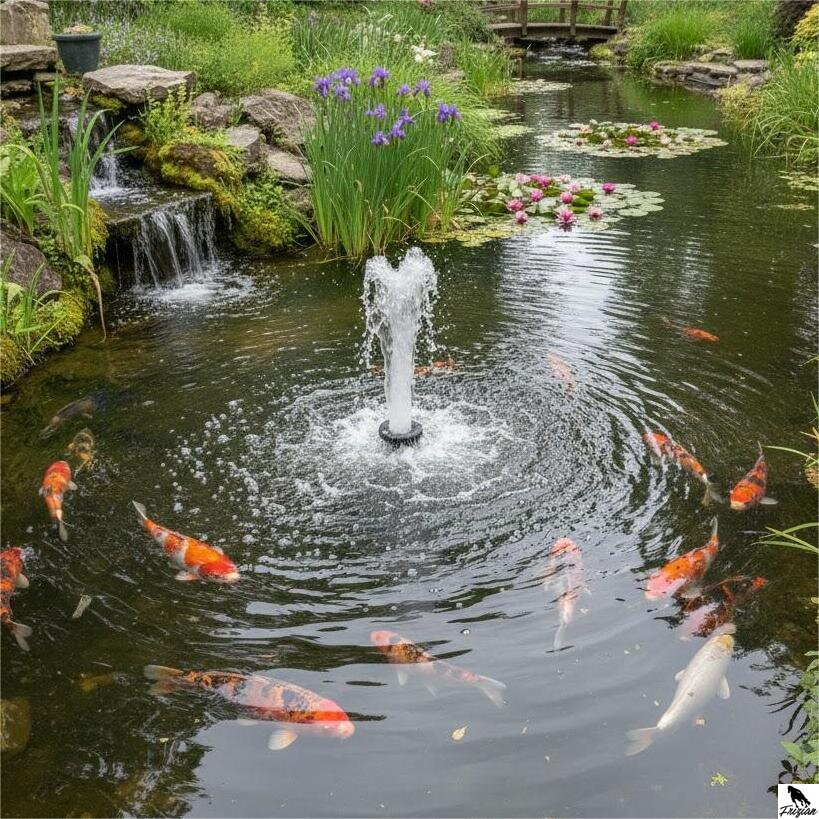
Fountain and waterfall aeration
Combining aesthetic function and water aeration.
Solar aeration
For ecological and mobile solutions, less power than a classic compressor.
🛠️ Advantages and disadvantages of aeration
Type of aeration Advantages Disadvantages
Classic compressor + stones Strong, effective aeration Electricity consumption, noisy
Solar compressor Ecological, without power supply Limited power, dependent on the sun
Fountains and waterfalls Aesthetics + aeration Milder effect on the bottom
Diffusers Even aeration Higher price, maintenance
🧠 How to choose aeration
According to the volume and depth of the pond
Small ponds (up to 5000 l): 1–2 air stones, small compressor.
Medium ponds (5000–20000 l): 2–4 stones, more powerful compressor.
Large ponds (>20000 l): several diffusers, strong compressor.
According to the number and type of fish
A lot of koi or sturgeon → higher oxygen demand.
Small ornamental fish → lower intensity.
According to aesthetic preferences
Fountains and waterfalls → combination of aeration and decoration.
Hidden stones on the bottom → discreet aeration.
According to the available energy
Network, solar panels, batteries.
Maintenance
Regular cleaning of air stones and hoses
Checking the compressor performance
📌 Practical recommendations
Aerate mainly in the warm months and in the evenings, when oxygen levels drop.
Place the air stones so that they cover the deeper parts of the pond.
Use an air flow regulator to prevent bottom turbulence.
Combine with biofiltration and a UV lamp to keep the water clean and healthy.
When wintering fish in the pond, ensure an open surface through aeration or heating devices.
🟢 Summary
Aeration is essential for a healthy and stable pond, especially with a high fish content and during hot days.
It increases oxygen in the water, promotes bacteria and filtration.
Prevents the formation of anaerobic zones and odors.
The correct selection of equipment and placement of aeration is crucial for effective operation.
Combined with filtration systems, bacteria and maintenance, it will ensure transparent and healthy water for fish and plants.
Tags
- Aeration is one of the most important elements of maintaining a healthy pond
- as it increases oxygen levels in the water
- promotes biological filtration
- and improves overall water quality. Proper aeration is especially crucial during the warmer months
- when oxygen levels naturally drop and fish are more susceptible to stress and disease.